











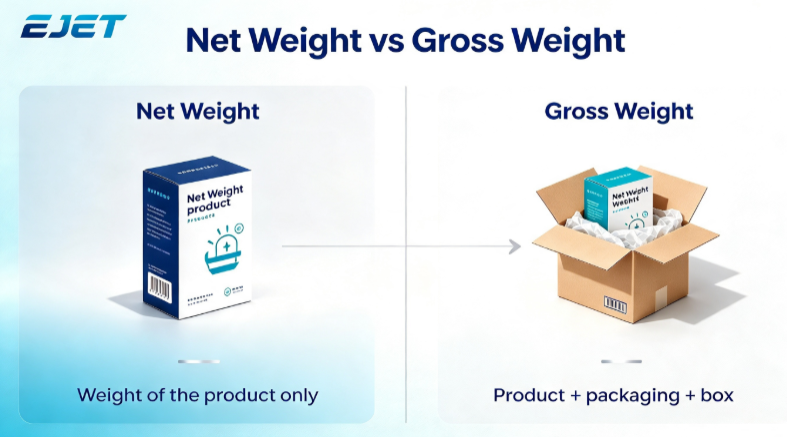
When dealing with products, packaging, shipping, or international trade, net weight vs gross weight is a distinction you cannot afford to overlook. Although the two terms sound similar, they refer to different measurements and serve different purposes.
Net weight generally tells you how much the actual product weighs, while gross weight typically includes the product together with its packaging.
Understanding this difference can help businesses avoid shipping errors, improve inventory records, prepare accurate trade documents, and communicate product quantities more clearly.
Think of it this way: if you buy a 5 kg bag of rice, the rice itself represents the net weight, while the rice together with its bag and other applicable packaging contributes to the gross weight.
That difference may seem insignificant when you're handling one package, but it can become substantial when hundreds or thousands of products are being manufactured, stored, or shipped.
In this guide, we'll break down net weight, gross weight, tare weight, their formulas, practical examples, and their importance in retail, logistics, and international trade so you can confidently tell which measurement you need in any situation.
What Is Net Weight?
Net weight is the weight of the actual product or goods without the weight of the packaging used to contain, protect, or transport them. If you buy a bag labeled “Net Weight: 5 kg,” the 5 kg refers to the product itself rather than the bag, box, wrapper, or other external packaging.
| Term | Meaning |
|---|---|
| Net Weight (N.W.) | Product alone — no box, no pallet, no wrapping |
| Tare Weight | Weight of packaging/container |
| Gross Weight (G.W.) | Net Weight + Tare Weight (total packed weight) |
In shipping terminology, UPS similarly defines net weight as the weight of the goods after packaging weight is excluded. The easiest way to picture net weight is to imagine opening a parcel, removing everything that exists purely to package the product, and then placing the product itself on a scale.
Whatever that scale shows is generally the net weight, assuming the relevant measurement rules do not specify otherwise. This distinction becomes especially important when a business sells goods by mass, because customers need to know how much actual product they are purchasing rather than how much the entire package weighs.
A 1 kg bag of rice, for example, should communicate the quantity of rice rather than the combined mass of rice plus the plastic bag. The same basic idea applies to many commodities, food products, chemicals, raw materials, and manufactured goods.
Net weight therefore answers a simple but commercially important question: How much actual merchandise is there? It is a product-focused measurement, while gross weight is generally a shipment- or package-focused measurement.
What Net Weight Includes
The exact treatment of packaging can depend on the product and the applicable rules, so “net weight” should not automatically be interpreted as “every physical object inside the outer box.”
Trade terminology can distinguish packaging that is considered part of the product from packaging used primarily for transport. UNECE trade terminology describes net weight as the mass of goods excluding transport packaging, while its broader documentation standards distinguish the treatment of packaging depending on the transaction and goods involved.
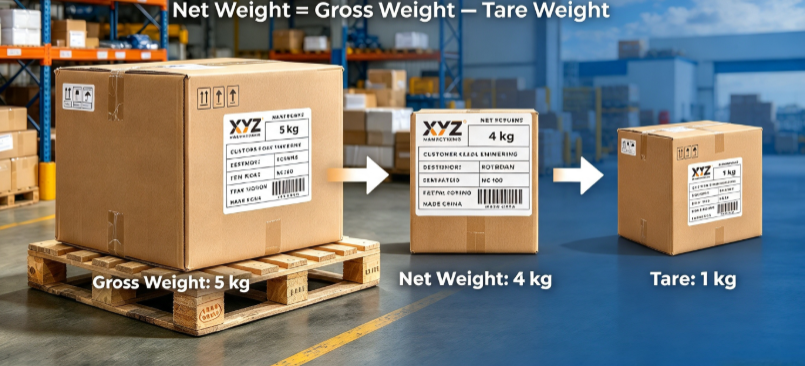
This is why businesses should use the definition applicable to their particular industry, destination market, customs procedure, or labeling requirement. Consider a glass jar containing 500 grams of jam. The jar, lid, label, and shipping carton all have physical mass, but the quantity of jam sold to the customer is 500 grams.
The net quantity is therefore what gives the buyer meaningful information about the merchandise itself. In manufacturing, the same principle might apply to a drum of chemicals, where the contents have one mass and the drum has another.
In logistics, separating these values allows companies to understand how much product they have purchased while also understanding how much physical mass must actually be handled and transported.
That distinction may seem small when dealing with one package, but it becomes significant when thousands of packages move through a warehouse or across an international border.
What Is Gross Weight?
Gross weight generally represents the combined weight of the goods and the packaging associated with the shipment. UNECE trade documentation defines gross weight as the mass of the goods including packaging but excluding the carrier's equipment. In practical terms, if a carton contains 10 kg of products and the carton, protective materials, and other relevant packaging weigh 1 kg, the gross weight is approximately 11 kg.
Gross weight is therefore the number that gives logistics teams a better picture of the physical mass they need to move. Think of it as the “ready-to-travel” weight: the product is no longer sitting naked on a warehouse shelf but has been boxed, protected, consolidated, and prepared for transportation. That distinction matters because trucks, aircraft, ships, handling equipment, storage systems, and freight carriers deal with the physical shipment rather than merely the contents.
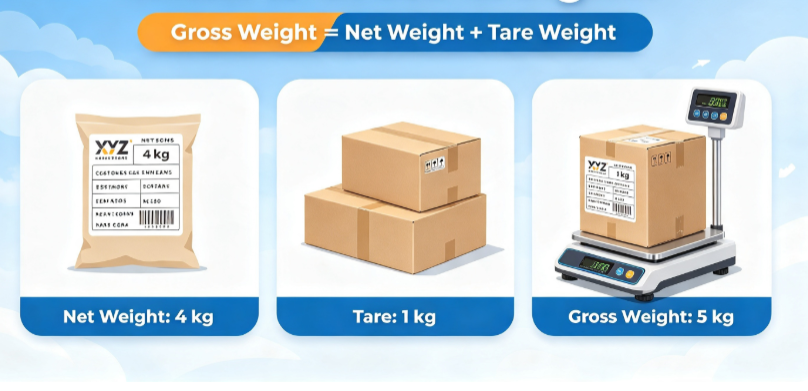
Gross weight can also be relevant to transport safety, documentation, warehouse planning, and freight calculations. However, it should not be confused with every possible definition of shipping weight. Depending on the transport mode and commercial arrangement, carriers may also use dimensional or volumetric weight when determining charges. UPS, for example, explains that chargeable weight can be based on actual gross weight or volumetric weight, whichever is greater under the applicable method. Thus, gross weight is a fundamental logistics measurement, but it is not necessarily the only weight figure used to calculate a shipment's final transportation charge.
What Gross Weight Includes
Gross weight normally incorporates the actual goods plus the packaging associated with those goods, but the exact scope should be checked against the relevant documentation rules. A shipment might contain individual retail units, inner packaging, cartons, protective materials, pallets, or other shipping components. Whether every one of these items is included in a particular gross-weight declaration can depend on the terminology being used.
UNECE documentation standards, for example, specifically distinguish the gross weight of goods from the equipment used by the carrier. This means you should not simply assume that “gross weight” always means the weight of absolutely everything from the product to the truck or shipping container. Imagine a pallet containing 50 cartons of electronic accessories. The products inside the cartons have one combined mass, while the cartons and internal protective materials add another amount.
The pallet itself may add still more mass, depending on the measurement and documentation context. If a warehouse employee places the fully prepared pallet on a calibrated industrial scale, the resulting measurement may represent the shipment's gross physical mass under that operational definition.
Accurate records become particularly important when several layers of packaging are involved because even a modest packaging difference multiplied across hundreds of shipments can materially affect logistics calculations. Gross weight therefore provides the operational bridge between the goods themselves and the physical shipment that actually enters the transportation network.
Net Weight vs Gross Weight: The Core Difference
The simplest distinction between net weight and gross weight is what each measurement is designed to represent. Net weight focuses on the goods themselves, while gross weight generally accounts for the goods plus relevant packaging. If a product weighs 20 kg and its packaging weighs 2 kg, the net weight is 20 kg and the gross weight is 22 kg, assuming the packaging falls within the applicable gross-weight definition.
The difference is conceptually similar to comparing the weight of a laptop with the weight of the laptop inside its retail box. The laptop's mass is useful for understanding the product, while the boxed laptop's mass is more useful for understanding what has to be moved through a delivery network. Neither number is inherently interchangeable with the other. A retailer might care deeply about net weight because it tells the customer how much merchandise is being sold, while a freight operator may need gross weight because it reflects the physical shipment.
UNECE's international trade terminology makes this distinction explicit by treating gross weight as goods including packaging and distinguishing net quantity from packaging-related mass. The practical lesson is simple: whenever you see a weight figure, ask “What exactly is included?” That one question prevents many errors. A number without its definition can be misleading because 22 kg of product is not the same thing as 22 kg of product plus packaging, and neither should automatically be treated as the weight of a vehicle, container, or entire transportation unit.
The Net Weight vs Gross Weight Formula
The basic relationship between net weight, packaging weight, and gross weight is straightforward. When the relevant definitions align, you can express it as Gross Weight = Net Weight + Packaging Weight. Rearranging the same relationship gives Net Weight = Gross Weight − Packaging Weight and Packaging Weight = Gross Weight − Net Weight.
| Term | Symbol | Formula |
|---|---|---|
| Net Weight | N.W. | Weight of goods only — no packaging |
| Tare Weight | T.W. | Weight of packaging/container only |
| Gross Weight | G.W. | N.W. + T.W. ← Total packed weight |
Suppose a carton contains products with a combined net weight of 18 kg, while the carton and applicable packaging materials weigh 2 kg. The gross weight is therefore 20 kg. These formulas are useful because they allow warehouse staff, purchasing teams, manufacturers, and logistics professionals to cross-check measurements instead of relying on a single figure. If a shipment record says the gross weight is 20 kg and the net weight is 18 kg, the implied packaging weight is 2 kg.
If another document says the same shipment has a gross weight of 25 kg, that discrepancy should be investigated rather than ignored. The mathematical relationship is simple, but real-world measurement becomes more complicated when different documents define packaging differently or when pallets, dunnage, straps, and other shipping materials are treated separately.
For that reason, businesses should establish a consistent internal weighing procedure and clearly identify whether a recorded weight is product-only, package-level gross weight, palletized gross weight, or another operational measurement. The formula is the starting point; the definition of each input is what makes the calculation meaningful.
How to Calculate Gross Weight
To calculate gross weight, first establish the net weight of the goods and then identify the weight of all packaging that the applicable definition requires you to include. Add those values together and document the unit of measurement. For example, if 100 units contain 250 grams of product each, the total net product weight is 25 kg. If the combined weight of the cartons and required packing materials is 3 kg, the resulting gross weight is 28 kg.
In a warehouse environment, however, the most reliable method may be to weigh the completed package directly using an appropriate calibrated scale and then reconcile that result against the expected net and packaging weights. Direct measurement can expose discrepancies caused by incorrect quantities, packaging substitutions, moisture, damaged materials, or data-entry mistakes. It is also important to avoid mixing kilograms and pounds without a clear conversion process.
International trade systems use standardized units and codes for quantities including mass, and UNECE Recommendation 20 provides standardized codes for units of measure used in international trade. A sound procedure therefore has three parts: identify what the measurement is supposed to represent, use an appropriate and calibrated weighing method, and record the unit and scope clearly. That approach makes the resulting number useful to everyone from the warehouse operator to the freight forwarder and customs documentation team.
What Is Tare Weight?
Tare weight is the weight of the container, package, or other weighing vessel without the goods being measured, although the exact application depends on the context. It is particularly useful because it provides the missing piece between net and gross measurements. If a container weighs 5 kg when empty and 45 kg when filled, the contents weigh 40 kg under that measurement setup.
In simple terms, the scale reading for the filled package represents the gross measurement, while the empty package represents tare, and the difference gives the contents. The concept becomes especially important in industrial weighing, freight operations, bulk commodities, and containerized transportation.
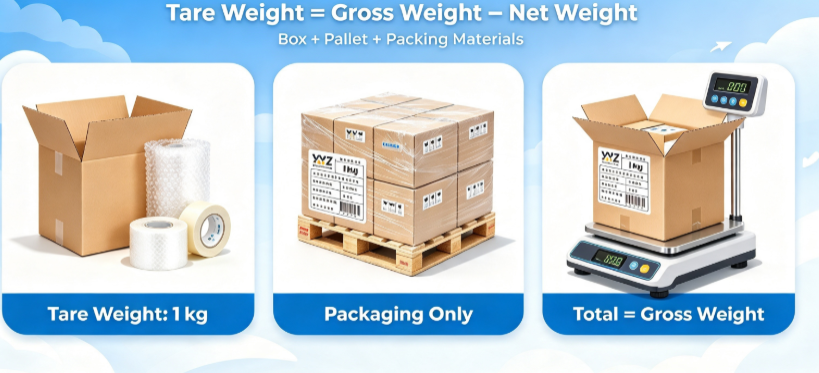
UNECE guidance on freight containers, for example, describes tare mass as the empty mass of the freight container and explains how maximum payload can be calculated by accounting for the container's tare mass and other applicable masses. This shows why tare should not simply be treated as another name for net weight. Tare describes the mass of the empty containing or transport unit, whereas net mass generally concerns the goods or contents. A practical example is a tanker, drum, tote, or reusable shipping container.
The container itself has weight even before anything is placed inside it. Recording that tare value allows operators to calculate the contents more accurately and helps prevent the accidental inclusion of container mass in product quantities.
Net Weight, Gross Weight, and Tare Weight Compared
The three terms work together like pieces of a simple accounting equation. Net weight tells you about the goods, tare weight tells you about the relevant empty packaging or container, and gross weight tells you about the combined mass under the applicable definition. If a box weighs 1.5 kg empty and contains 10 kg of merchandise, the gross weight of the filled box is 11.5 kg. The net weight is 10 kg, while the tare weight is 1.5 kg.
This distinction is useful because different departments may need different numbers from the same shipment. A merchandising team may use net weight to describe the product to customers, a warehouse may use gross weight to determine handling requirements, and a weighing operation may use tare weight to determine how much material is inside a container.
The terminology can become more complicated for pallets, containers, vehicles, and multimodal freight because additional equipment can enter the measurement chain. UNECE's freight-container guidance, for example, separates the container's tare mass from the cargo payload and identifies additional attached or securing items in its payload calculation. The key is not to memorize one universal rule for every scenario. Instead, identify the object being weighed, identify what is included, and use the definition required by the relevant commercial or regulatory process.
Why Net Weight Matters in Retail
Net weight is especially important in retail because it communicates the amount of actual product that the customer is purchasing. Imagine two cereal boxes that look almost identical from the outside, but one contains 400 grams and the other contains 500 grams. The packaging alone does not tell the shopper the true product quantity; the net quantity does. The same principle applies to rice, flour, coffee, frozen food, pet food, detergents, cosmetics, hardware, and countless other products sold by mass.
From a business perspective, net weight also supports inventory management because companies can compare the quantity of raw materials purchased with the quantity of finished goods produced and sold. When product specifications are expressed in kilograms, grams, pounds, or ounces, a consistent net-weight system helps maintain accurate purchasing and production records. It can also make product comparisons easier for consumers because the quantity is separated from the packaging materials.
This is why confusing net weight with gross weight can cause practical problems. A package could weigh substantially more than its advertised product quantity because it contains glass, metal, cardboard, protective inserts, or other packaging. The customer generally wants to know how much usable product they are receiving. Net weight provides that product-centered measurement, while gross weight remains more relevant to the physical package and its movement through the supply chain.
Why Gross Weight Matters in Shipping
Shipping companies and logistics teams need to understand the physical mass of the shipment they are moving, which makes gross weight an important operational figure. A carrier cannot plan a shipment solely around the mass of the merchandise inside a carton because packaging contributes to the load that vehicles, aircraft, handling equipment, and warehouse systems must accommodate. Gross weight can therefore affect shipment planning, handling procedures, documentation, and, depending on the service, freight pricing.
UPS explains that chargeable weight can be based on actual gross weight or dimensional weight, with the applicable calculation using whichever is greater under the carrier's methodology. This is a useful reminder that gross weight and chargeable weight are not automatically the same thing. A lightweight but bulky package may occupy more transportation space than its scale weight suggests, making dimensional weight commercially relevant. At the same time, a dense package may have a high actual weight that determines its charge.
Gross weight is therefore one part of the larger logistics equation. It also has a practical safety dimension because accurate mass information helps businesses avoid planning around an incorrect physical load. When hundreds of cartons are consolidated, a small error in each carton can become a significant difference across the complete shipment. Accurate gross-weight records give logistics teams a more reliable picture of what is physically moving.
Net Weight vs Gross Weight in International Trade
International trade makes the distinction between net and gross weight particularly important because shipments may pass through multiple organizations, documents, systems, and jurisdictions. An exporter, importer, customs broker, freight forwarder, warehouse, carrier, and regulatory authority may all encounter weight information during the movement of the same goods. UNECE's trade-document standards include standardized concepts for gross weight and net quantity, reflecting the need for consistent data across international commercial documentation.
A mismatch does not necessarily mean that someone made a fraudulent or careless declaration; it can sometimes arise because two parties used different definitions or included different packaging components. That is precisely why weight fields need clear descriptions and consistent measurement procedures. Businesses engaged in international commerce should not assume that a number labeled simply “weight” will have the same meaning everywhere.
They should identify the relevant customs, transport, product-labeling, and contractual requirements for the shipment and destination. The stakes can be higher when large quantities are involved because a small per-unit difference can multiply across a container or entire order. Good documentation effectively creates a shared vocabulary: everyone knows whether the number refers to net merchandise, packaged goods, a palletized shipment, or another defined measurement. That clarity reduces avoidable disputes and makes supply-chain data much easier to reconcile.
The Role of Customs Documentation
Customs documentation relies on precise descriptions of merchandise, and weight information can form part of the data used to identify and process an international shipment. The specific requirements vary by jurisdiction, commodity, and declaration type, so businesses should always follow the applicable customs rules rather than relying on a generic formula. UNECE's standardized trade terminology exists partly because international transactions require common data concepts and codes that can be understood across systems.
Its Recommendation 20, for example, provides standardized codes for units of measure used in international trade, including mass-related units. The practical lesson is that a number without a unit or definition is incomplete. “10,000” could mean grams, kilograms, pounds, or another unit, while “10,000 kg gross” communicates something materially different. Businesses should also maintain consistency between commercial invoices, packing lists, warehouse records, and shipping documentation where the same measurement is intended.
If the figures differ because the documents measure different things, that distinction should be understandable rather than accidental. Strong documentation practices make the supply chain easier to audit and reduce the possibility that an employee has to reconstruct what a weight figure meant after the shipment has already left the warehouse.
Net Weight vs Gross Weight for Freight Costs
Freight costs can involve more than simply multiplying a shipment's net weight by a rate. Carriers may consider gross weight, dimensional weight, shipment dimensions, service type, destination, and other pricing factors. UPS's explanation of chargeable weight illustrates this clearly: actual gross weight and volumetric weight can both be considered, with the applicable chargeable measure being the greater one under the carrier's rules.

This means a company could have a product with a very low net weight but still face significant transportation costs because the packaging creates a large physical volume. Conversely, dense goods may have relatively little packaging but a high actual mass. Consider a shipment of foam products. The net weight might be modest, but the cartons could fill considerable space inside a delivery vehicle. A shipment of metal components might occupy less space while weighing much more.
The two shipments behave differently from a logistics-pricing perspective even if their net weights were identical. That is why businesses should keep net weight and gross weight separate from chargeable-weight concepts. Net weight describes the merchandise; gross weight describes a broader physical shipment measurement; chargeable weight is a pricing concept determined by the carrier's applicable methodology. Treating those three terms as interchangeable can lead to incorrect shipping estimates and unexpected invoices.
Examples of Net and Gross Weight
Consider a simple example involving 12 boxes of coffee. Each box contains 1 kg of coffee, giving the shipment a total net weight of 12 kg. Suppose the cardboard boxes and relevant protective packaging collectively weigh 1.8 kg. The gross weight would then be 13.8 kg if that packaging is included under the applicable definition. Now imagine that the shipment is placed on a wooden pallet weighing 15 kg.
Depending on the measurement being requested, the palletized shipment could weigh 28.8 kg, but that does not necessarily mean the documented gross weight for every commercial or customs purpose should automatically be 28.8 kg. The important issue is the scope of the measurement. If the question is “How much coffee is being sold?”, 12 kg is the relevant answer. If the question is “How much do the packaged cartons weigh?”, 13.8 kg may be relevant.
If the question is “How much does the palletized unit physically weigh?”, 28.8 kg may be the operational measurement. The numbers themselves are not contradictory because they answer different questions. This is one of the most important ideas to understand about net versus gross weight: a single shipment can legitimately have several different weight figures, provided each figure is clearly defined. Problems occur when people copy one number into a document that requires another.
Example: Food Packaging
Food products provide some of the clearest examples of the difference. Imagine a jar containing 500 grams of sauce. The sauce is the merchandise, so its net quantity is 500 grams. The glass jar, lid, label, and perhaps other packaging add mass, meaning the complete packaged product weighs more than 500 grams. If ten jars are placed in a cardboard shipping carton, the total gross mass of that carton will be greater again. The product label may focus on the quantity of food, while the warehouse or shipping documentation may need a packaged weight. The distinction becomes particularly important when products are sold in large quantities.
A manufacturer shipping 10,000 jars cannot treat the weight of the sauce and the weight of all the glass and cartons as though they were the same measurement. Inventory planners need product mass; production teams need material quantities; logistics teams need shipment mass; and customers need accurate product quantity information. The same pattern appears with canned foods, bottled drinks, bags of grains, frozen products, and other packaged commodities.
The physical package is effectively a protective shell around the merchandise, and net weight looks inside that shell while gross weight looks at the packaged unit. Keeping the two measurements separate makes the information useful to different parts of the supply chain without forcing one number to perform several incompatible jobs.
Example: Shipping Cartons and Pallets
Suppose a company ships 40 cartons, with each carton containing 8 kg of merchandise. The total net weight is 320 kg. If each carton weighs 0.75 kg, the cartons contribute 30 kg, producing a packaged gross weight of 350 kg before considering any additional shipping materials. If the goods are secured on a 20 kg pallet, the fully palletized unit physically weighs 370 kg. Each of these figures has a different operational meaning. The purchasing department might care about the 320 kg of merchandise.
The packaging department might care about the 30 kg of carton material. The warehouse may need to know that the palletized unit weighs 370 kg for handling purposes. A carrier may then apply its own chargeable-weight methodology, potentially considering dimensional weight as well as actual weight. The lesson is not that one of these numbers is “the real weight.” They are all real measurements of different configurations of the same goods.
The crucial question is which configuration and definition the document or process requires. When businesses establish standardized weighing procedures, they can record these values separately instead of allowing employees to guess. That improves inventory accuracy, shipping estimates, warehouse safety, and communication between suppliers and customers.
Common Mistakes When Recording Weight
One of the most common mistakes is simply confusing net weight with gross weight. Another is failing to identify whether pallets or other shipping materials are included. A third mistake is recording a weight without specifying the unit, which creates unnecessary ambiguity in international and domestic operations. Businesses can also run into trouble when employees copy an old packaging weight even though the company has changed carton suppliers or protective materials.
Small packaging differences can accumulate quickly when multiplied across large shipments. Another frequent problem is treating gross weight as synonymous with chargeable weight, even though carriers may use dimensional calculations as part of their pricing methodology. There can also be discrepancies caused by scales that are poorly maintained, incorrectly zeroed, or unsuitable for the size and precision of the goods being measured. The solution is not complicated, but it requires discipline.
Every weight record should answer three basic questions: What was weighed? What was included? What unit was used? If those details are clear, many apparent discrepancies become easy to explain. If they are missing, even a correct number can become practically useless because nobody knows what it represents. Good weight management is therefore less about complicated mathematics and more about consistent definitions, measurement, documentation, and verification.
How to Measure Net and Gross Weight Correctly
Accurate measurement starts by selecting a suitable scale and establishing exactly what you are trying to measure. For net weight, place only the goods on the scale, or use an appropriate tare function when the goods must remain in a container. For gross weight, weigh the complete package or shipment configuration required by the relevant process. If tare is being used, confirm that the scale has correctly captured the empty container's mass before adding the contents.
The scale should be appropriate for the expected weight range and maintained according to the organization's measurement procedures. After weighing, record the value together with the unit and a description of what was included. For larger logistics operations, businesses can build these measurements into warehouse management or enterprise systems so that employees do not have to retype values repeatedly.
UNECE's standards for units of measure are designed to support consistent representation of quantities in international trade, reinforcing the importance of standardized measurement terminology. A useful quality-control process is to compare the measured gross weight with the expected net weight plus packaging weight. If the difference is unexpectedly large, investigate before the shipment leaves. This simple reconciliation can identify missing goods, extra materials, incorrect product counts, or data-entry mistakes early, when they are much easier to correct.
Net Weight vs Gross Weight on Product Labels
On consumer products, net weight or net quantity generally exists to communicate the amount of merchandise rather than the complete package mass. This is why you may see statements such as “Net Weight 500 g” on food packages or other goods sold according to mass. The packaging can weigh considerably more or less depending on whether the product uses a plastic pouch, glass jar, metal can, cardboard box, or another container. A consumer comparing two products needs a meaningful way to compare the quantities being offered, rather than comparing the combined mass of merchandise and packaging.
Businesses therefore need to treat labeling as a separate issue from shipping documentation. The number printed on a retail package should not simply be replaced with a warehouse gross weight because the two figures serve different purposes. At the same time, companies shipping those products need additional information about the physical package because transportation depends on the shipment as prepared for movement.
This creates a natural division of responsibilities: product labeling communicates merchandise quantity, while logistics records communicate shipment characteristics. Exact labeling requirements vary by jurisdiction and product category, so businesses should follow the applicable local rules rather than assuming that one universal labeling standard applies everywhere. The underlying principle, however, remains easy to understand: the product quantity and the packaged shipment mass answer different questions.
Why Accurate Weight Records Matter for Businesses
Weight data touches surprisingly many parts of a business. Purchasing teams use it to understand how much material enters the organization. Production teams use it to measure inputs and outputs. Inventory teams use it to reconcile physical stock. Packaging teams use it to evaluate materials. Warehouse teams use it for storage and handling. Logistics teams use it to plan transportation, while finance teams may use shipment data to investigate freight costs.
In international trade, consistent weight terminology also helps organizations communicate across commercial and documentation systems. UNECE's trade standards specifically support standardized data representation for international transactions, including weight and unit-of-measure concepts. A mistake that begins as a small packaging-weight error can therefore travel through several departments. Imagine a company that records every carton as 2 kg heavier than it actually is.
One carton is insignificant, but 5,000 cartons create a 10,000 kg discrepancy in the company's records. That can affect freight planning, inventory analytics, and reconciliation work. Accurate weight records also create a stronger audit trail because employees can explain why a particular figure appears on an invoice, packing list, or warehouse record. In modern supply chains, where data moves between many digital systems, clear definitions are just as important as accurate scales. A precise number attached to the wrong definition is still bad data.
Quick Comparison Table
| Feature | Net Weight | Gross Weight |
|---|---|---|
| Basic meaning | Weight of the goods/product under the applicable definition | Weight of goods plus relevant packaging |
| Main focus | Merchandise | Packaged shipment |
| Packaging included? | Generally excluded | Generally included |
| Common use | Product quantity, inventory, sales | Shipping, handling, logistics |
| Example | 20 kg of rice | 22 kg of rice plus packaging |
| Customer relevance | Shows how much product is supplied | Usually less important for product quantity |
| Logistics relevance | Useful for cargo calculations | Important for physical shipment planning |
| Formula relationship | Gross weight − applicable packaging weight | Net weight + applicable packaging weight |
| Same as chargeable weight? | No | Not necessarily |
| Same as tare weight? | No | No |
The comparison is simple, but the details matter. UNECE defines gross weight in trade-document terminology as the mass of goods including packaging while distinguishing net quantity from that broader figure. UPS likewise describes net weight in shipping as the goods' weight excluding packing or packaging.
At the same time, businesses should remember that carrier pricing may introduce another concept—chargeable weight—which can involve actual gross weight or dimensional weight. In other words, net weight, gross weight, tare weight, and chargeable weight are related but distinct concepts. Using the right term in the right situation makes documentation much easier to understand and reduces the risk of costly misunderstandings.
Frequently Asked Questions About Net Weight vs Gross Weight

1. Is net weight the same as product weight?
In many ordinary commercial contexts, net weight represents the weight of the actual goods without transport packaging, so it is commonly used as the product weight. However, the precise definition can depend on the product and applicable rules. UNECE trade terminology distinguishes net quantity from gross weight and packaging-related measurements.
2. Is gross weight always net weight plus the pallet?
Not necessarily. Gross weight definitions vary according to the context and documentation being prepared, so you should determine whether the pallet and other shipping materials fall within the specific measurement being requested. A palletized physical weight can certainly include the pallet, but that does not automatically mean every gross-weight field should be populated with the palletized figure.
3. What is the easiest formula for gross weight?
When the definitions align, use Gross Weight = Net Weight + Packaging Weight. For example, 50 kg of goods plus 5 kg of applicable packaging gives a gross weight of 55 kg.
4. Does gross weight determine shipping cost?
It can, but not always by itself. Carriers may compare actual gross weight with dimensional or volumetric weight when calculating chargeable weight. UPS explicitly describes chargeable weight as potentially being based on whichever is greater under its applicable actual-versus-volumetric calculation.
5. Why do net and gross weight both appear on shipping documents?
Because they answer different questions. Net weight identifies the quantity of goods, while gross weight gives a broader measurement of the goods together with relevant packaging. Having both figures helps different parties understand the shipment accurately and reconcile the documentation.
Conclusion
Understanding net weight vs gross weight becomes much easier once you stop thinking of them as competing numbers and start viewing them as measurements with different jobs. Net weight tells you how much of the actual merchandise you have, while gross weight generally tells you how much the merchandise weighs together with its relevant packaging.
Tare weight helps identify the mass of the empty container or packaging, while chargeable weight introduces a separate logistics concept that may incorporate actual or dimensional weight. UNECE's international trade terminology and UPS's shipping guidance both reinforce the importance of keeping these concepts distinct.

.png)