













A quality control checklist is one of the most important tools for ensuring that manufactured products meet specified quality, safety, performance, and packaging requirements.
Whether we source products from China, manage overseas suppliers, operate a manufacturing facility, or prepare goods for international shipment, a structured QC inspection checklist helps us identify defects, prevent costly mistakes, and maintain consistent product quality.
Without clearly documented inspection requirements, manufacturers and suppliers may interpret product specifications differently.
These inconsistencies can result in defective merchandise, incorrect dimensions, damaged packaging, regulatory noncompliance, customer complaints, and expensive product returns.
By implementing a comprehensive quality control inspection checklist, we establish measurable acceptance criteria, improve communication with suppliers, and ensure that inspections follow consistent procedures.
In this guide, we explain how to develop an effective QC checklist, identify critical inspection checkpoints, classify product defects, apply Acceptable Quality Limit (AQL) sampling methods, and manage quality inspections throughout the manufacturing process.
What Is a Quality Control Checklist?
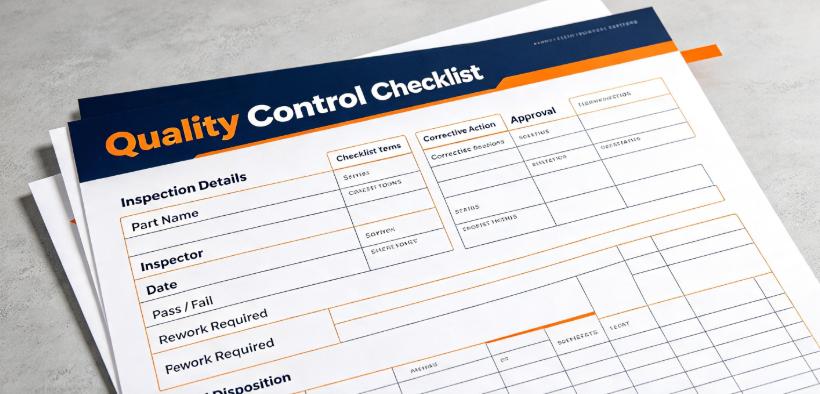
A quality control checklist, also called a quality inspection checklist, QC checklist, or product inspection checklist, is a structured document used to verify whether manufactured products meet predetermined specifications and quality standards.
It provides inspectors, manufacturers, suppliers, and quality assurance teams with a consistent framework for evaluating product quality.
A comprehensive checklist typically includes:
-
Product specifications: Dimensions, materials, weight, color, construction, and appearance.
-
Workmanship requirements: Surface finish, assembly quality, stitching, welding, and structural integrity.
-
Functional testing: Product operation, performance, durability, and reliability.
-
Packaging inspection: Carton strength, protective materials, labeling, and shipping requirements.
-
Safety and compliance: Applicable regulations, test reports, certification requirements, and warning labels.
-
Defect classification: Critical, major, and minor defects.
-
Sampling procedures: Inspection levels, sample sizes, and acceptance criteria.
-
Inspection documentation: Results, measurements, photographs, and corrective actions.
We use these requirements to transform subjective quality expectations into objective, repeatable inspection standards.
Why Is a Quality Control Checklist Important?
An effective quality control checklist supports every stage of the manufacturing and sourcing process.
1. Prevents Defective Products From Reaching Customers
Product defects can damage brand reputation and increase operational costs.
By inspecting products against predefined requirements, we can identify issues such as incorrect materials, manufacturing defects, poor workmanship, and functional failures before shipment.
Early detection also allows manufacturers to investigate and correct problems before they affect larger production quantities.
2. Improves Communication With Suppliers
Ambiguous product specifications frequently lead to manufacturing errors.
For example, requesting a blue plastic container without specifying the exact color reference, material grade, dimensions, and acceptable tolerances leaves considerable room for interpretation.
A detailed QC checklist eliminates much of this uncertainty by documenting requirements that both buyers and suppliers can verify.
3. Reduces Returns and Rework Costs
Defective products generate additional expenses through replacement shipments, refunds, repairs, repackaging, and customer service.
When we detect problems during production rather than after delivery, corrective action is often less expensive and easier to implement.
4. Supports Regulatory Compliance
Products sold in different markets may be subject to specific safety, labeling, chemical, electrical, and environmental regulations.
A QC checklist helps us verify that required compliance documentation, markings, and inspection activities are complete.
However, a checklist alone does not establish legal compliance. We must also obtain appropriate testing, technical documentation, and conformity assessments when required.
5. Creates Consistent Quality Standards
When multiple inspectors evaluate the same product, inconsistent criteria can produce conflicting results.
By using standardized checkpoints and defect definitions, we improve inspection consistency across factories, production batches, and suppliers.
Complete Quality Control Inspection Checklist Template
The following template provides a practical starting point for manufacturing quality inspections.
|
Inspection category |
Quality control checkpoint |
Acceptance criteria |
|---|---|---|
|
Product identification |
Model, SKU, and description |
Match approved specifications |
|
Materials |
Material type and grade |
Match approved bill of materials |
|
Dimensions |
Length, width, height |
Within specified tolerances |
|
Weight |
Individual product weight |
Within approved range |
|
Color |
Product color and finish |
Match approved reference sample |
|
Workmanship |
Scratches, cracks, dents |
Meet defined cosmetic standards |
|
Assembly |
Component alignment and fastening |
Secure and correctly assembled |
|
Functionality |
Product operating performance |
Pass specified functional tests |
|
Safety |
Sharp edges and hazardous conditions |
No prohibited safety hazards |
|
Labeling |
Product labels and markings |
Accurate, legible, and compliant |
|
Packaging |
Retail packaging condition |
Undamaged and properly sealed |
|
Cartons |
Shipping carton construction |
Meet packaging specifications |
|
Quantity |
Units and carton counts |
Match purchase order |
|
Documentation |
Test reports and records |
Required documents available |
|
Final inspection |
Sampling and defect assessment |
Meet agreed acceptance criteria |
We should customize this template according to the product category, manufacturing process, intended market, and customer requirements.
1. Product Specification Quality Control Checklist
Product specifications establish the foundation of a successful quality inspection.
Material Quality Inspection
We must verify that manufacturers use the approved materials and components.
Depending on the product, material inspection may involve:
-
Confirming plastic resin grades and material composition.
-
Checking metal type, thickness, hardness, and corrosion resistance.
-
Verifying fabric composition, weight, and construction.
-
Inspecting wood species, moisture content, and surface treatment.
-
Reviewing material certificates and traceability records.
-
Confirming that restricted substances meet applicable limits.
For example, a stainless steel kitchen accessory specified as grade 304 should not be substituted with a different grade without approval.
Material substitutions can affect corrosion resistance, durability, performance, and product safety.
Dimensions and Weight Inspection
Dimensional accuracy is essential for products requiring precise assembly, compatibility, or packaging.
We should define:
Nominal dimensions: The intended measurements shown in approved drawings.
Permitted tolerances: The acceptable variation from each nominal dimension.
Measurement methods: The instruments and procedures used during inspection.
Measurement conditions: Any temperature, positioning, or other conditions that could affect results.
For example, a product with a specified length of 200 mm and a tolerance of ±1 mm must measure between 199 mm and 201 mm.
Inspectors may use digital calipers, micrometers, measuring tapes, gauges, or calibrated weighing equipment.
Color and Appearance Inspection
Color differences can significantly affect customer satisfaction, especially for branded consumer products.
We recommend comparing production samples with an approved physical master sample or an appropriate color reference system, such as Pantone.
Where necessary, inspection requirements should also specify lighting conditions, viewing distance, surface texture, and acceptable color variation.
Common appearance defects include scratches, discoloration, stains, uneven coatings, bubbles, dents, and inconsistent surface finishes.
Structural Integrity and Assembly Inspection
A product may look acceptable while containing structural weaknesses.
We therefore inspect component alignment, fastening strength, adhesive bonding, weld quality, stitching consistency, and overall stability.
For assembled products, we should also verify that all required components are present and correctly positioned.
2. Workmanship and Visual Inspection Checklist
Workmanship inspection focuses on the visible and physical quality of manufactured products.
A detailed workmanship checklist should identify the types of defects that inspectors must evaluate.
|
Defect type |
Example |
Typical classification |
|---|---|---|
|
Sharp exposed edge |
Edge capable of causing injury |
Critical |
|
Broken functional component |
Switch does not operate |
Major |
|
Incorrect product dimensions |
Outside functional tolerance |
Major |
|
Visible surface scratch |
Prominent scratch on front surface |
Major or minor |
|
Slight cosmetic imperfection |
Small mark in a concealed area |
Minor |
|
Loose structural connection |
Component may detach during use |
Major or critical |
|
Missing required warning |
Mandatory safety warning absent |
Potentially critical |
These classifications are illustrative. We must define them according to the actual product risks, contractual requirements, and applicable regulations.
Photographic examples are particularly valuable because they demonstrate the difference between acceptable and unacceptable workmanship.
For cosmetic products, we recommend documenting inspection zones, viewing distance, lighting conditions, and the maximum permissible size or number of imperfections.
3. Functional Testing Quality Control Checklist
Functional testing verifies whether products perform their intended operations correctly.
Visual inspection alone cannot identify every manufacturing defect.
We should therefore establish functional tests that reflect normal operating conditions and foreseeable product use.
Electrical and Electronic Products
Depending on the product, we may inspect:
-
Power-on and power-off functions.
-
Buttons, switches, and indicators.
-
Battery charging and discharge behavior.
-
Display performance.
-
Connectivity and communication functions.
-
Voltage and current measurements.
-
Temperature during operation.
-
Applicable electrical safety characteristics.
Electrical safety testing must follow the relevant product standard and should be performed by appropriately qualified personnel using suitable equipment.
Mechanical Products
Mechanical inspection may include operating force, moving-part alignment, fastening strength, load-bearing performance, and repeated operation.
Textile and Apparel Products
Functional and performance tests may include seam strength, zipper operation, button attachment, fabric shrinkage, colorfastness, and dimensional stability.
Furniture Products
Furniture inspections may assess structural stability, load resistance, joint strength, surface durability, and assembly completeness.
Every test should have a documented procedure and measurable acceptance criterion.
4. Packaging Quality Control Checklist
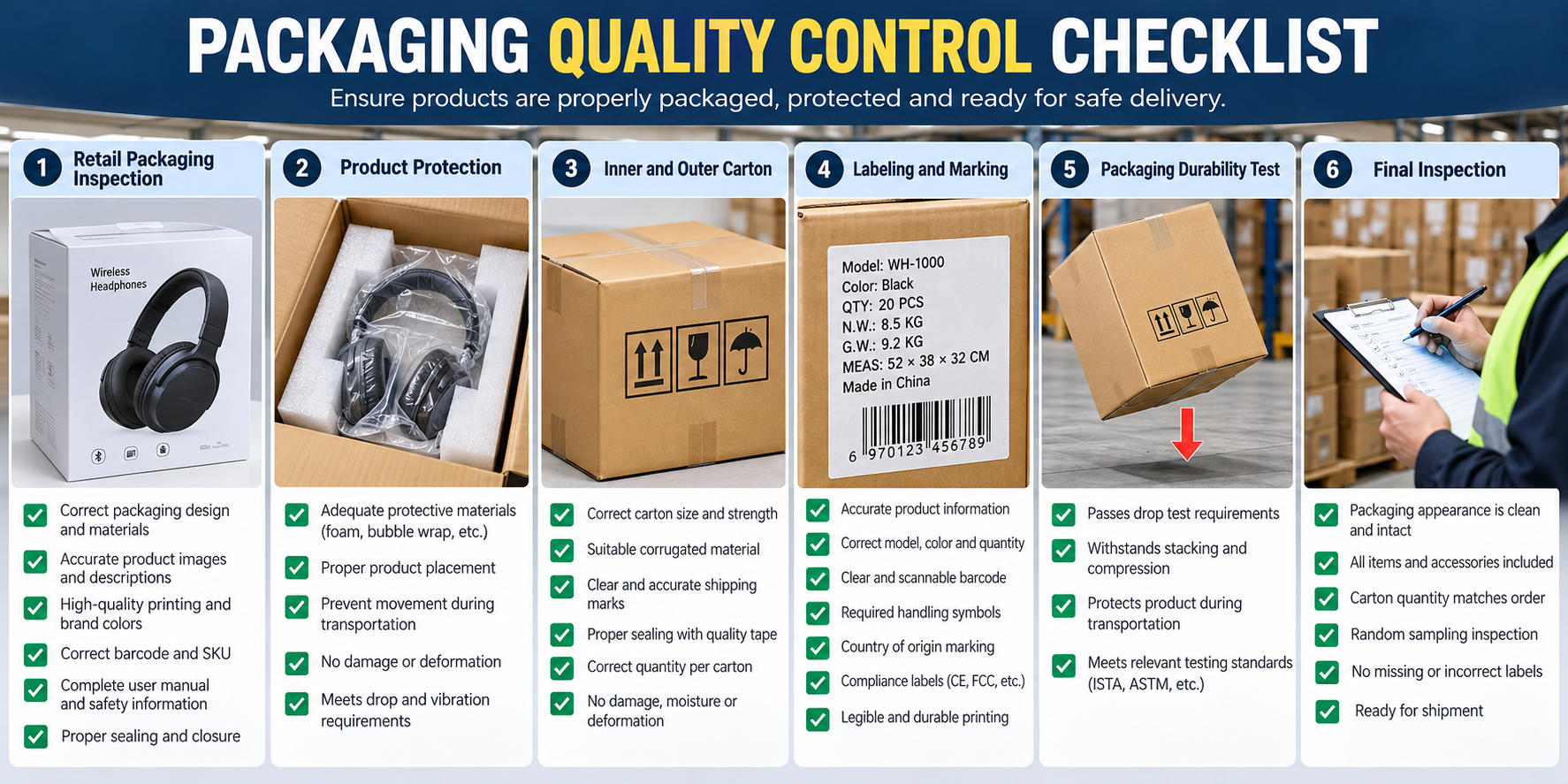
Packaging quality is essential for protecting products during storage, handling, transportation, and final delivery.
Poor packaging can result in damage even when the products themselves leave the factory in perfect condition.
Retail Packaging Inspection
We should verify that retail packaging meets approved design and construction requirements.
Inspection checkpoints include:
-
Correct packaging dimensions and materials.
-
Accurate product images and descriptions.
-
Consistent printing quality and brand colors.
-
Correct barcode information.
-
Complete product instructions.
-
Required warnings and regulatory markings.
-
Proper sealing and closure.
-
Appropriate protective inserts.
Export Carton Inspection
Shipping cartons must withstand the anticipated distribution environment.
We should check carton dimensions, board construction, sealing method, product arrangement, gross weight, and stacking requirements.
Carton strength requirements should reflect product weight, transportation methods, storage conditions, and handling risks.
Packaging Drop Testing
Packaging drop tests help evaluate whether packaged products can withstand defined handling impacts.
The appropriate test method, drop height, orientation, and acceptance criteria depend on the product and distribution requirements.
Recognized methods include applicable procedures from ISTA and ASTM D5276.
A successful test should demonstrate that the packaging provides the agreed level of protection without unacceptable product damage.
Shipping Marks and Carton Labels
We should verify that outer cartons display the information required by the purchase order, logistics provider, and destination market.
This may include product identification, carton numbers, quantity, gross weight, net weight, dimensions, handling symbols, and destination information.
5. Product Safety and Regulatory Compliance Checklist
Safety and regulatory requirements must be considered before manufacturing begins.
Different products and destination markets may require different conformity assessments, testing procedures, and technical documentation.
|
Product category |
Potential compliance considerations |
|---|---|
|
Children's toys |
EN 71, applicable toy safety regulations, CPSIA |
|
Electrical equipment |
Applicable IEC/EN standards, electrical safety requirements |
|
Wireless electronics |
FCC requirements, EU Radio Equipment Directive |
|
Food-contact products |
Applicable food-contact material regulations |
|
Cosmetics |
Ingredient restrictions, labeling, product safety requirements |
|
Textiles |
Fiber labeling, chemical restrictions, flammability where applicable |
|
Furniture |
Applicable stability, strength, and safety requirements |
The applicability of these requirements depends on the exact product, intended use, destination market, and current legislation.
For example, CE marking is not a universal product quality certification. It indicates conformity with applicable EU legislation requiring that marking, supported by the appropriate conformity assessment.
Similarly, FCC authorization and UL certification address different requirements and are not interchangeable.
We should verify all applicable obligations before approving products for sale.
6. Defect Classification in Quality Control
A reliable QC inspection checklist must define how defects are categorized.
The three most commonly used categories are critical defects, major defects, and minor defects.
Critical Defects
Critical defects create unacceptable safety risks or involve serious violations of applicable requirements.
Examples may include exposed live electrical parts, dangerous sharp edges on children's products, or other conditions presenting significant hazards.
Inspection plans commonly specify zero acceptance for observed critical defects.
Major Defects
Major defects significantly affect product function, usability, appearance, or marketability.
Examples include a broken zipper, nonfunctional control button, substantial dimensional error, or incorrect product component.
Minor Defects
Minor defects generally involve limited cosmetic or workmanship imperfections that do not materially affect intended product use.
Examples include small surface marks or slight visual inconsistencies within defined limits.
Defect classification should always be approved before inspection begins.
7. Understanding AQL in Quality Control Inspections
Acceptable Quality Limit (AQL) is a key concept in statistical acceptance sampling.
AQL-based inspection plans help us determine how many units to inspect and the acceptance or rejection criteria for a production lot.
The widely used ISO 2859-1 standard provides sampling procedures for inspection by attributes.
Common AQL Inspection Levels
General inspection levels typically include:
-
Level I: Smaller samples for situations where reduced inspection intensity is appropriate.
-
Level II: Commonly used for routine general inspections.
-
Level III: Larger samples for more extensive inspection.
Special inspection levels may be used when smaller samples are appropriate for particular tests.
Commonly Selected AQL Values
For ordinary consumer products, buyers and inspection companies sometimes specify:
|
Defect category |
Example AQL |
|---|---|
|
Critical |
0 acceptance, by agreement |
|
Major |
2.5 |
|
Minor |
4.0 |
These are examples rather than universal requirements.
Importantly, AQL 2.5 does not mean that exactly 2.5% defective products are permitted in every inspected shipment.
The actual acceptance and rejection numbers depend on the lot size, inspection level, selected AQL, sampling plan, and applicable switching rules.
A sampling inspection also cannot guarantee that every unit in an accepted lot is defect-free.
AQL Sampling Example
Suppose we order 5,000 units of a consumer product.
Under a commonly used ISO 2859-1 single-sampling plan with General Inspection Level II and normal inspection, the sample size is 200 units.
For this particular sample plan, the illustrative acceptance criteria are:
|
Defect category |
AQL |
Acceptance number |
Rejection number |
|---|---|---|---|
|
Major |
2.5 |
10 |
11 |
|
Minor |
4.0 |
14 |
15 |
Critical defects may be subject to a separate zero-acceptance requirement.
We should confirm the applicable standard edition, inspection severity, and agreed plan before applying these numbers.
8. Quality Control Checklist for Every Manufacturing Stage
Quality inspections are most effective when performed at appropriate stages of production.
Pre-Production Inspection (PPI)
Before mass production, we verify that the supplier understands all technical and quality requirements.
Key checkpoints include approved samples, materials, production equipment, manufacturing instructions, packaging specifications, and testing requirements.
During Production Inspection (DUPRO)
During production, we inspect partially completed and finished goods to identify problems before the entire order is manufactured.
This stage is particularly valuable for new products, complex assemblies, and suppliers with inconsistent quality performance.
Pre-Shipment Inspection (PSI)
Pre-shipment inspection evaluates finished products before dispatch.
We verify product specifications, workmanship, functionality, packaging, labeling, quantities, and other contractual requirements.
The inspection should take place when enough goods are finished and accessible to allow representative sampling.
Container Loading Inspection
During loading, we can verify carton quantities, shipping marks, container condition, loading procedures, and visible cargo protection.
Container loading inspection complements product inspection but does not replace it.
9. How to Create a Professional Quality Control Checklist
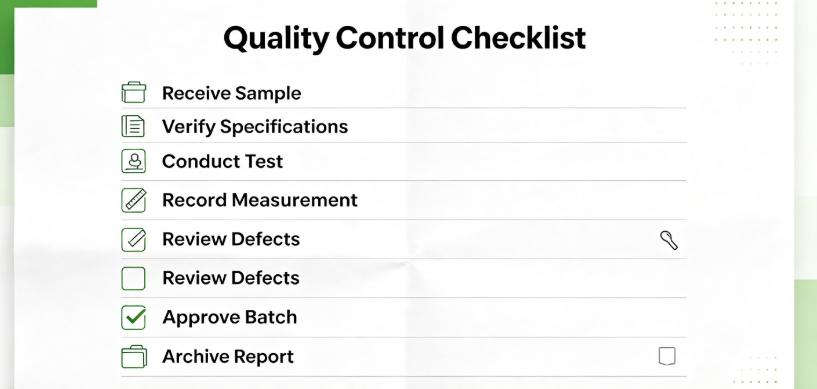
We can develop an effective checklist through a structured process.
Step 1: Collect Product Specifications
We begin with approved drawings, purchase orders, bills of materials, reference samples, packaging artwork, and applicable standards.
Step 2: Identify Product Risks
We identify likely manufacturing failures and evaluate their consequences.
A risk-based approach helps prioritize safety-critical characteristics, important functions, and recurring defects.
Step 3: Define Measurable Acceptance Criteria
Every checkpoint should specify what is acceptable, how it will be evaluated, and what constitutes failure.
Instead of writing "good surface finish," we should define the permitted defect size, location, quantity, and inspection conditions.
Step 4: Select Inspection Methods
We determine whether each checkpoint requires visual inspection, measurement, functional testing, documentation review, or laboratory analysis.
Step 5: Establish Sampling Requirements
We document the lot definition, inspection level, sampling method, AQL values, and acceptance criteria.
Step 6: Approve the Checklist With the Supplier
The buyer, manufacturer, and inspection team should agree on requirements before production.
Step 7: Record Inspection Results
Inspectors should document actual measurements, observed defects, photographs, sample quantities, and pass/fail results.
Step 8: Implement Corrective Actions
When inspections reveal nonconformities, we should investigate causes, establish corrective actions, verify their effectiveness, and perform reinspection when appropriate.
10. Quality Control Inspection Report Template
A professional inspection report should provide enough evidence to support an informed shipment decision.
|
Report field |
Information required |
|---|---|
|
Inspection reference |
Unique report number |
|
Supplier |
Factory or manufacturer name |
|
Product |
Description, model, SKU |
|
Purchase order |
PO number |
|
Inspection date |
Date and location |
|
Order quantity |
Total ordered units |
|
Available quantity |
Units available for inspection |
|
Sample size |
Number of units inspected |
|
Sampling plan |
Standard, level, and AQL |
|
Critical defects |
Number identified |
|
Major defects |
Number identified |
|
Minor defects |
Number identified |
|
Test results |
Functional and safety test outcomes |
|
Packaging results |
Carton and labeling findings |
|
Photographic evidence |
Product and defect images |
|
Inspection conclusion |
Pass, fail, or pending disposition |
|
Corrective action |
Required resolution and responsibility |
We recommend retaining inspection records alongside purchase orders, product specifications, and supplier communications.
11. Common Quality Control Mistakes to Avoid
Even experienced purchasing teams can encounter avoidable inspection problems.
Using vague inspection requirements: Subjective descriptions lead to inconsistent decisions.
Inspecting only finished products: Late detection can make corrections expensive.
Failing to approve reference samples: Inspectors need reliable benchmarks.
Ignoring packaging quality: Transport damage can undermine otherwise acceptable manufacturing quality.
Using incorrect sampling procedures: Poorly selected samples may not adequately represent the production lot.
Failing to document defects: Missing evidence makes supplier disputes harder to resolve.
Treating inspection as a substitute for testing: Visual checks cannot verify every safety or regulatory requirement.
Shipping before corrective actions are verified: Unresolved defects can create downstream losses.
We can reduce these risks through standardized procedures, inspector training, clear supplier agreements, and consistent documentation.
12. Best Practices for Improving Manufacturing Quality Control
A checklist becomes more effective when it is integrated into a broader quality management process.
We recommend maintaining controlled document versions so inspectors always use current specifications.
We should also review recurring defects and update inspection criteria when new risks emerge.
Supplier performance can be evaluated through metrics such as defect rates, inspection failure frequency, corrective-action closure time, customer returns, and on-time delivery.
Where practical, we can apply root-cause analysis methods such as the 5 Whys and fishbone diagrams to identify why defects occur.
For high-risk or recurring problems, corrective and preventive action procedures should address the underlying manufacturing process rather than simply replacing defective units.
Over time, this approach helps us move from detecting defects toward preventing them.
Frequently Asked Questions About Quality Control Checklists
What is the main purpose of a quality control checklist?
The main purpose is to verify that products meet documented specifications, quality standards, and applicable requirements through a consistent inspection process.
What should a quality control checklist include?
It should include product identification, materials, dimensions, appearance, workmanship, functionality, packaging, labeling, safety requirements, defect classifications, sampling procedures, and inspection results.
What is the difference between quality control and quality assurance?
Quality assurance (QA) focuses on establishing and improving processes intended to prevent quality problems. Quality control (QC) focuses on verifying whether products or outputs meet defined requirements.
Both contribute to an effective quality management system.
What is an AQL inspection checklist?
An AQL inspection checklist combines product inspection requirements with an acceptance sampling plan. It helps inspectors determine the sample size and whether observed defects meet the agreed lot acceptance criteria.
Is a quality control checklist necessary for importing from China?
A documented QC checklist is strongly recommended when sourcing from China or any other manufacturing market. It provides clear requirements for suppliers and third-party inspectors and helps reduce misunderstandings and shipment-related quality risks.
Can a quality control checklist guarantee defect-free products?
No. A checklist improves inspection consistency and defect detection, but sampling inspections cannot guarantee that every manufactured unit is defect-free.
How often should a quality control checklist be updated?
We should review it whenever product specifications, materials, manufacturing processes, regulations, or customer requirements change. Recurring defects and inspection findings may also justify revisions.
Conclusion: Build a Reliable Quality Control System With a Comprehensive QC Checklist
A well-designed quality control checklist is essential for maintaining product consistency, improving supplier accountability, and reducing manufacturing risks.
By documenting clear product specifications, inspection methods, defect classifications, packaging requirements, regulatory obligations, and sampling procedures, we create a repeatable framework for evaluating manufactured goods.
The most effective approach combines pre-production verification, in-process inspection, pre-shipment quality control, appropriate product testing, and documented corrective actions.
When we treat quality control as an ongoing manufacturing discipline rather than a final inspection activity, we strengthen supplier performance, protect customer satisfaction, and improve long-term product reliability.

_1751507038923.png)