












On July 28, 1985, The New York Times published a lengthy article prominently titled “The Danger from Japan.” The author, Theodore H. White, was no longer the unknown young journalist he once was. By then, he was a Pulitzer Prize-winning authority on Asian affairs.
In this article, he posed a provocative and soul-searching question for Americans:
Who really won the war?
White detailed a series of events from the 1970s and 1980s, portraying the rapid and massive influx of Japanese products into the U.S. market, and how American manufacturing crumbled under the weight of this competition.
In his view, the competitive onslaught from Japanese goods led to severe losses in the U.S. textile, steel, shipbuilding, automotive, and consumer electronics industries. The garment industry alone, which once provided two million jobs, had shrunk to 750,000 positions in just a decade.
Under pressure from Japanese Yamaha pianos, only one American piano manufacturer remained. Even the shipyard that had once launched the USS Missouri was shut down due to the decline of the shipbuilding industry.
The irony was striking: the United States had defeated Japan in World War II and subsequently helped rebuild it into a peaceful ally. Yet, in this new era of economic rivalry, Japan had used that peace to corner the U.S., contributing little while forcing America into a defensive position.
The article concluded with a clear warning: Japan must recognize that it needs the United States far more than the U.S. needs Japan. If Japan's economic policies were to provoke American lawmakers too far, a U.S. market closure would hurt Japan much more than the reverse. White reminded readers that only four decades earlier, Japan's attack on Pearl Harbor had led it inexorably to surrender on the deck of the USS Missouri.
The piece deeply resonated with many Americans. At the time, members of the United Auto Workers smashed a Japanese car with sledgehammers during a protest—a scene that drew cheering crowds.
Clearly, protectionist sentiment was gaining traction in the United States.
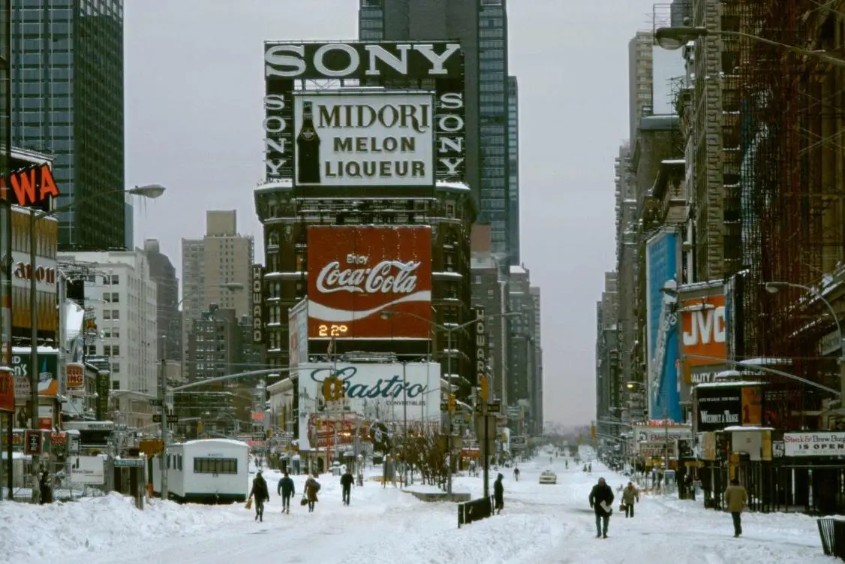
American streets at this time/Source: Online
In contrast, Japan and Western Europe were experiencing economic booms. Both Germany and Japan were running growing trade surpluses. For Japan, it was a golden era of rapid economic growth and rising international standing. By 1968, Japan’s GDP had surpassed that of West Germany, making it the second-largest economy in the West.
Despite two global oil crises between 1973 and 1985, Japan still managed an average annual growth rate of 3.6%, a strong performance among developed nations.
In 1979, Harvard professor Ezra Vogel published the influential book Japan as Number One, which marked a shift in how Americans viewed Japan. The book’s subtitle, Lessons for America, urged the U.S. to learn from Japan’s model of success.
The first chapter was titled “Learning from Japan.” This was a period when Japanese politicians, business leaders, and citizens alike felt a profound sense of pride. A prevailing belief in Japan at the time was that it had become even stronger than the United States.
_1744180163293.jpg)
"Japan First" by Ezra Vogel/Source: Online
A popular booklet published in Japan in the late 1980s, The Japan That Can Say No, captured this sentiment of national confidence brought on by economic prosperity.
However, the persistent trade deficit began to alarm the U.S. business community. Capitalists, members of Congress, and economists called for government intervention in currency markets to rescue American manufacturing—fearing that Japan might “peacefully occupy” the United States.
This time, the proposed solution was not tariffs—but foreign exchange.
The logic was simple: a weaker dollar and a stronger yen would make U.S. goods more competitive and revive domestic manufacturing.
James Baker, then U.S. Secretary of the Treasury, with the backing of President Ronald Reagan and Federal Reserve Chairman Paul Volcker, initiated negotiations with Japan, West Germany, the UK, and France. The aim was a coordinated intervention to drive up the yen and the Deutsche Mark, leading to a dollar devaluation.
To Baker’s surprise, Japan not only accepted but showed great enthusiasm.
Before the agreement, the dollar-yen exchange rate stood at 1:240. The U.S. initially proposed a devaluation to 1:216.
Japan responded: You’re being too modest.
The U.S. asked: Then what do you suggest?
Japan replied: Why not 1:200—or even more?
The Fed Chairman later recalled, “The Japanese were far more generous than we expected.”
As a result, the agreement was finalized swiftly. On September 22, 1985, representatives of the five nations signed the Plaza Accord at the famed Plaza Hotel in New York—in just one day.
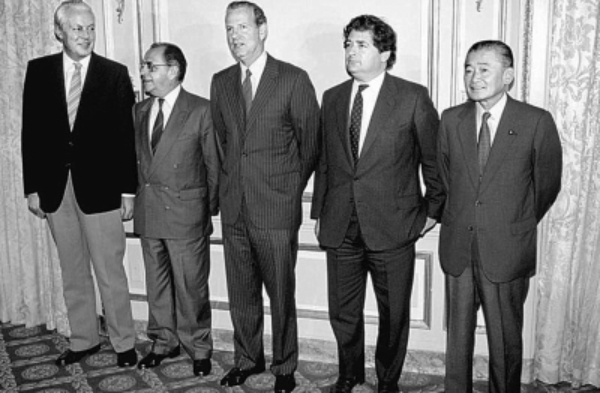
Five finance ministers who signed the Plaza Accord/Source: Online
The long-term impact of the Plaza Accord remains the subject of debate.
Some argue it triggered Japan’s asset bubble and led to the “Lost Two Decades” of stagnation. Others believe the agreement was unrelated to Japan’s eventual downturn. Let us set that discussion aside and focus on its impact on the United States.
The core objective of the Plaza Accord was to reduce the U.S. trade deficit by weakening the dollar. Between 1985 and 1987, the dollar depreciated by about 50% against the yen, from 1:240 to around 1:120. In the short term, this boosted U.S. export competitiveness.
However, the data shows that the trade deficit with Japan and other countries did not significantly narrow. Despite improved export performance in sectors such as automobiles and machinery between 1986 and 1988, structural issues in U.S. industry meant the overall trade imbalance persisted.
As one of the most consequential economic agreements of the 1980s, the Plaza Accord had deep and complex implications. Although it provided a temporary boost to U.S. exports, it failed to resolve the underlying causes of the trade deficit.
Meanwhile, Japan suffered a severe blow. The soaring yen contributed to an enormous economic bubble, and its eventual burst led to decades of stagnation and financial strain.
This pivotal episode in global economic history underscores the complexity and brutality of international economic competition. It reminds us that economic policymaking must involve careful deliberation and long-term thinking.
Today, as we stand at a new historical crossroads, reflecting on this chapter offers valuable lessons. The world should embrace openness and cooperation in international trade—not confrontation and protectionism.

_1751507038923.png)